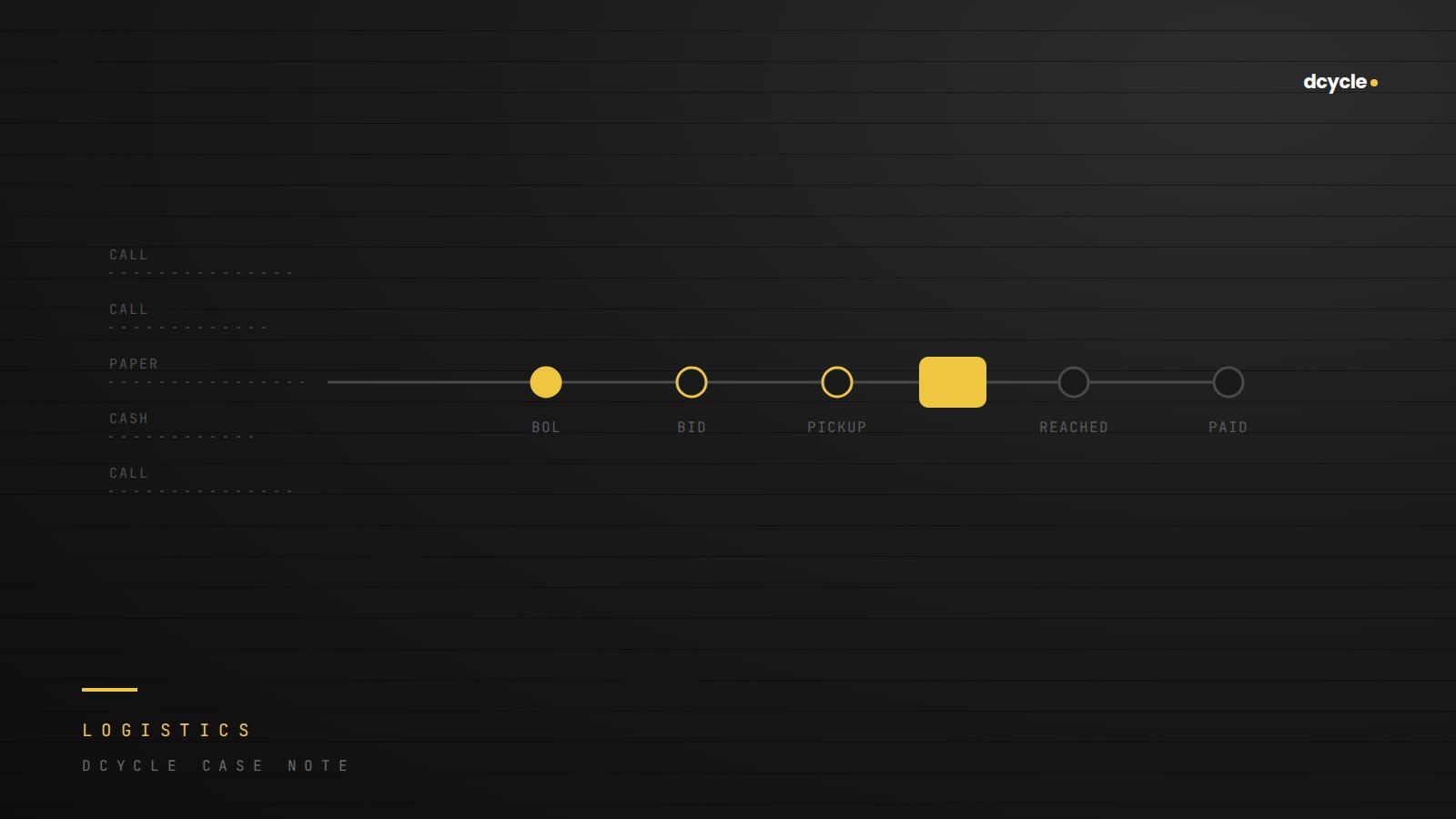
The real competitor was the phone call
For our client, a freight and logistics business, moving a load worked the way it still works for most of the industry. A customer calls a transporter they know. The transporter calls around for a free truck. Rates get agreed on the phone, paperwork travels on paper, payment happens in cash or on a promise, and for the whole trip someone keeps calling the driver to ask where the truck is.
None of that is broken from the inside. Everyone knows how it works, and that is exactly why taking it online is harder than it looks. A logistics app does not compete with another app. It competes with a phone call that already works, mostly.
If the app is slower than calling someone, people will call someone.
They came to us with that clutter and a clear goal: move the whole business online, in a way that the people who use it every day would actually prefer. We designed and developed both the web application and the mobile app. These are the decisions that mattered most.
Four people, four very different days
The first week was not about screens. It was about who touches a shipment and what each of them needs at that moment. There turned out to be four:
- The customer who needs something moved. They want to post a load quickly, compare offers and know where their goods are without chasing anyone.
- The transporter who runs a fleet. They manage trucks and drivers, look for loads that fit their vehicles and decide what to bid.
- The freelance driver with their own truck. They are a business of one: they find loads, bid and drive.
- The admin who keeps the network trustworthy by checking who is allowed in.
Mapping roles early settled questions that would otherwise have surfaced late and expensively. A driver who works for a transporter cannot bid; only the transporter's manager can. A freelance driver can bid, and when they win, the shipment is assigned to them automatically, with no assignment step. Small rules like these decide whether the product feels obvious or confusing, and they are much cheaper to settle on paper than in code.
It also decided the platform split. Customers and transporter managers spend real time planning, comparing and managing a fleet, so they get a full web application as well as mobile. Drivers live on their phones, often in a cab, so the mobile app is designed around them.
Start from the paperwork people already trust
Every load in this industry already has a document attached to it: the Bill of Lading. It lists pickup, delivery, equipment, commodity, shipper and consignee. People know how to fill it in.
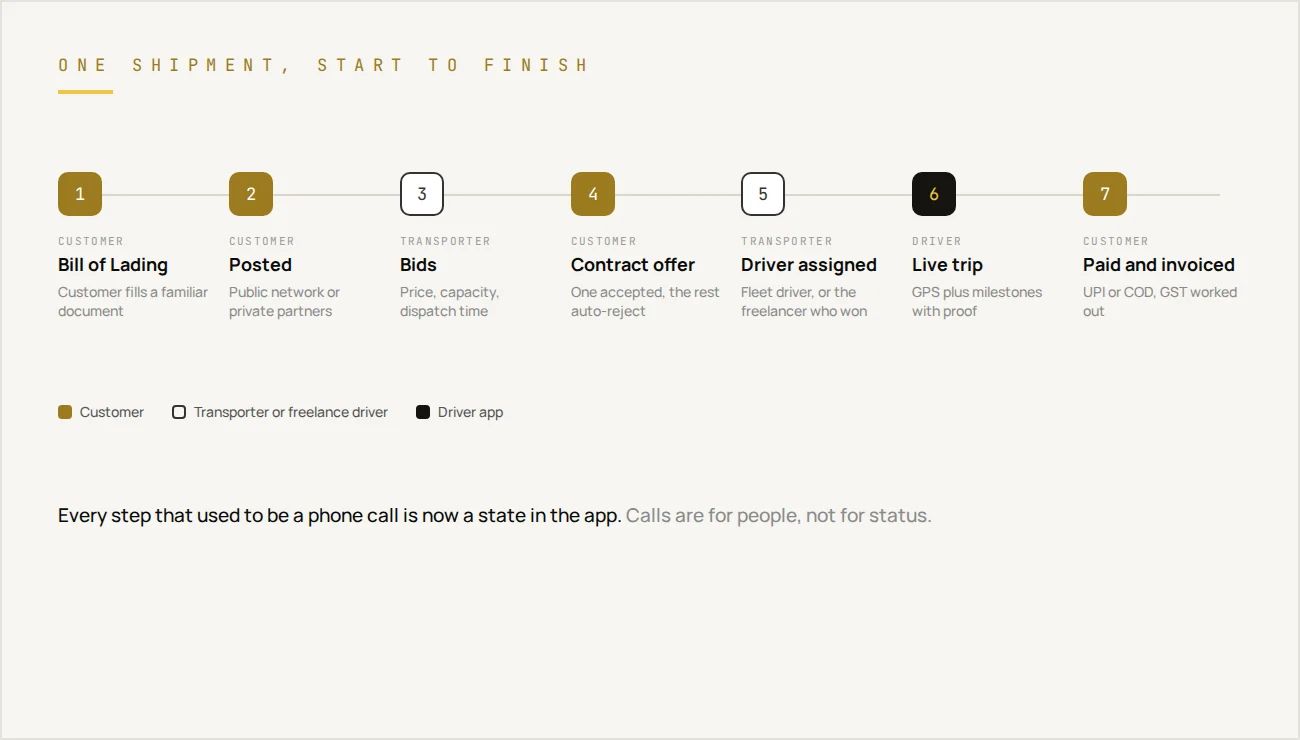
So instead of inventing a new "create shipment" form, we made the Bill of Lading the starting point. The customer fills in a document they recognise, and the system creates the shipment from it automatically. The customer can review and edit before anything goes out, and the same document is generated again at the end with the invoice.
The lesson travels well beyond logistics. When you take an offline process online, start from the artefact people already use. It removes a whole layer of training.
Turn phone negotiation into a clear flow
On the phone, negotiation is quick but invisible. Nobody can compare three offers side by side, and nobody has a record of what was agreed. We replaced it with a flow that keeps the speed and adds the record:
- Post the load. The customer publishes the shipment, either to the public network or privately to transporters they already work with. The private option matters: existing relationships are the industry's real asset, and the product had to respect them, not replace them.
- Bid. Transporters and freelance drivers see open loads on a load board and bid with a price, capacity and dispatch time. Transporters can also post their available trucks so customers can find them.
- Offer. The customer accepts a bid or sends a contract offer, which the transporter accepts or rejects.
- Lock it. The moment one bid is accepted, every other bid is rejected automatically. A shipment can only ever have one accepted transporter, which removes the classic double-booking problem.
After that, people still talk on the phone. We did not try to replace every call, only the ones that existed because information was missing.
Answer "where is my truck?" before anyone asks
The most common call in logistics is a status question. The product answers it in two layers.
Live location. Once a trip starts, the driver's phone shares GPS until delivery. Drivers can start, pause, resume and stop a trip, and tracking stops on its own when the shipment is marked delivered, so nobody is tracked a minute longer than needed.
Milestones with proof. Location alone does not tell a customer much. So the trip is broken into the steps people actually care about: pickup completed, in transit, reached, delivered. The transporter marks each one with a photo or document as proof.
One practical detail shaped the driver app more than any visual decision. Phones aggressively stop background apps to save battery, which quietly breaks live tracking. The app guides drivers to switch off battery optimisation and keep the phone charging during an active trip. It is not glamorous, but it is the difference between a tracking feature and a tracking feature that works on a real highway.
Money that matches how the industry pays
Payment is where most logistics apps either over-design or under-design. We tried to mirror reality:
- UPI and cash on delivery. Cash is still common, so it is supported. But every cash payment is logged as an activity too, so the record is complete either way.
- Milestone payments. Customers can split payment across the trip, with a set amount or percentage due at each milestone. Payment follows proof, which earns trust on both sides.
- No mental arithmetic. Platform commission, GST and payment gateway charges are calculated automatically, and invoices and Bills of Lading are generated by the system.
- Close cleanly. A shipment cannot be closed while payments are pending, so nothing slips through.
Trust before access
An open marketplace for trucks only works if people trust who is on the other end. Every customer, transporter and freelance driver registers with OTP verification and unique contact details. Transporters submit their company, vehicle and driver details; drivers are verified with identity and licence documents; and an admin approves or rejects each account, truck and driver before they can take part.
It adds a step at sign-up. It removes a much bigger problem later.
If your logistics business still runs on calls and paper
Every project is different, but these are the lessons we would pass on to any logistics owner going digital:
- Map the roles before the screens. Who can bid, who can assign, who sees what. Most confusion later comes from rules nobody wrote down.
- Digitise the documents people already trust, rather than inventing new forms.
- Keep existing relationships. A private network for known partners makes adoption far easier than forcing everyone onto an open market.
- Design the driver app for the cab. Large targets, few steps, clear errors that point to the exact field, and tracking that survives a phone trying to save battery.
- Let payment follow proof. Milestones with photos settle more disputes than any support team.
If your operation is still held together by phone calls, spreadsheets and paper slips, tell us how it works today. We will map it with you and show you what the first version of going online should look like.