The premise most agencies get wrong
The pitch usually goes like this: we use AI, so we're faster, so you pay less. But speed is rarely what holds up product development. Decisions hold it up. If a team generates forty screens in an afternoon and can't say which three matter, the slow part has only moved downstream, into review, then development, and eventually a rewrite.
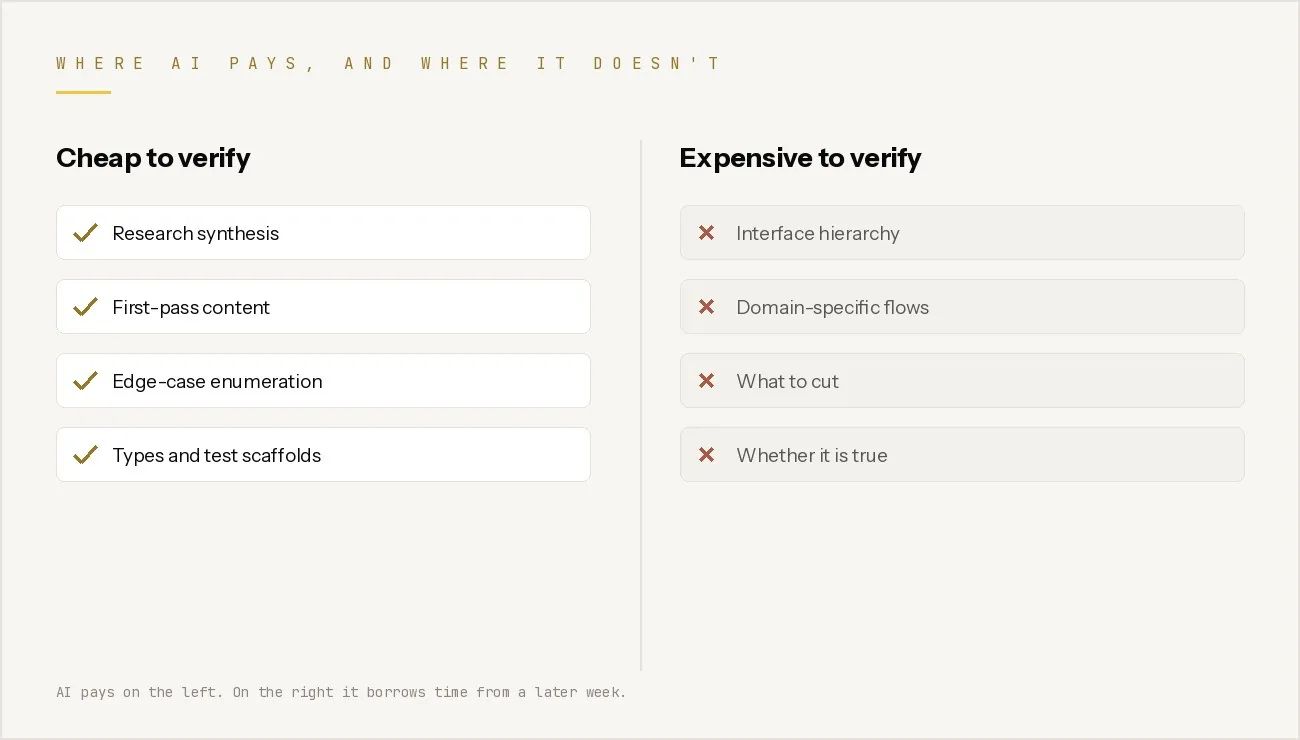
So we ask a narrower question. Which steps are bounded, repetitive and cheap to verify? AI pays for itself on those. On everything else, the time it saves this week gets spent again later.
Where it saves days
Across the work we've shipped, it comes down to four places:
- Research synthesis. Sorting twenty interview transcripts into themes is tedious, and it's easy to verify, because you can check any claim against the transcript in seconds. This is the strongest case of the four.
- First-pass content. Empty states, error copy, form labels and the ninety other strings nobody wants to write. The designer edits a draft instead of starting from nothing, which is faster.
- Edge-case enumeration. Asking what breaks in a flow brings up the expired card, the half-typed address and the two open tabs earlier than a review would.
- Boilerplate in development. Types, test scaffolds and migrations, where a machine can check that the result is correct.
All four have one thing in common: checking the output takes less time than producing it did. That is the only rule we use to decide.
Where it costs a week
Interface design from a text prompt is the obvious failure, even though the output often looks fine. A screen carries decisions about hierarchy, about what the user came to do, and about what happens when something goes wrong. A generated screen looks as if those decisions were made when nobody made them, and you find that out in development.
The second failure is harder to spot. AI is confidently wrong about the details of a domain. Ask it for a freight quoting flow and you get something that would convince anyone who has never quoted freight. We've shipped in logistics, in regulated finance and in clinical practice, and each time the design came out right because we talked to someone who does the job.
AI gives you something shaped like an answer. Whether it's true is a separate question, and most of design is answering that one.
The four checks before anything AI-assisted ships
We run four checks, and each one has caught a real problem:
- Provenance. Can we say where every factual claim came from? If we can't source it, we cut it.
- A human made the structural call. A person decides hierarchy, flow order and what gets cut, and that person can explain the decision to the client.
- It survives the real data. Generated layouts assume tidy content, so we run them against the longest real name, the empty list and the 400-character description.
- Someone who does the job has read it. For domain work, a person from the client's team reads the flow before we develop it.
What this looks like on a real engagement
On a six-week MVP, AI does a lot in week one and very little in week five. Week one is synthesis, edge cases and first-pass content, all of it bounded and easy to check. By week five we're deciding what to cut to hold the date, and those are conversations between the people who will answer for the result.
Overall it takes maybe a fifth of the hours out of a project, almost all of them from the parts nobody enjoyed. Someone still has to decide what the product is.