Cost is the wrong first question
Most founders I talk to start by comparing a day rate with a salary. That comparison misleads in both directions. A salary leaves out recruiting time, ramp-up, equipment, tooling, the hours someone spends managing the designer, and the risk that the hire doesn't work out. An agency's rate leaves out the time your own team spends briefing and reviewing.
Add all of that up and the two come out closer than people expect, because good design costs roughly the same wherever you buy it. So I'd set price aside and ask what you're buying. In-house gets you continuity. An agency gets you range.
In-house buys continuity
An in-house designer builds up memory, and an agency can't match it. They know why that flow is odd, which customer complained, and what was tried in 2024 and failed. After a year, that context is worth more than raw craft.
In-house is the right answer when the product is your whole business, when design decisions come up every day instead of arriving as projects, and when you have someone who can give a designer direction. Founders tend to underestimate that last condition. A designer with no product direction will produce beautiful work that solves the wrong problem, and it usually takes about six months for anyone to notice.
An agency buys range and a start date
I'd hire an agency in three situations. The first is when you need several skills at once and none of them full-time, say research, interface design, front-end and back-end. The second is when you need to start now: hiring well takes about three months, and you may not have them. The third is when the work is a project with an end, like a redesign, an MVP or a design system.
A studio also gets to see the same problem in different settings. We have fifty-seven documented projects across eight sectors, so when a checkout problem turns up in one of them, we've usually met it in three others. An in-house designer knows one product, yours, far more deeply than we ever will. You'll need both kinds of knowledge at different times.
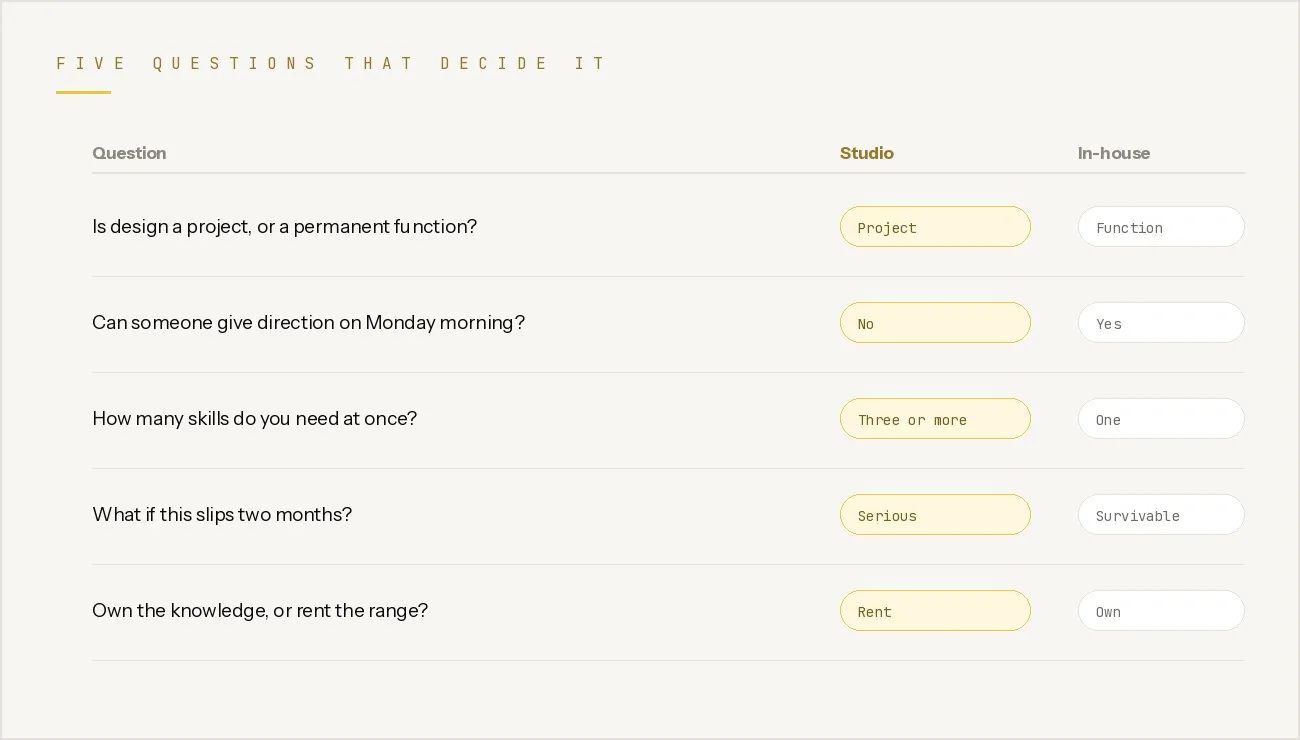
Five questions that decide it
- Is design a project or a permanent function here? A project points to an agency. A permanent function points to in-house, eventually.
- Can someone give a designer direction on Monday morning? If nobody can, an in-house hire will underperform no matter who you pick.
- Do you need more than one skill? If it's one, hire it. If it's four, you're describing a team.
- What happens if this slips two months? If that would really hurt, hiring is too slow.
- Would you rather own the knowledge or rent the range? Most founders know their answer to this one as soon as they hear it.
The answer is often both, in sequence
The pattern we see most often is a studio developing v1, then a first designer being hired around the time the product has real users and a real roadmap. That order works well. The agency takes on the risky, wide-ranging early phase, and the in-house hire inherits something coherent to work from.
That's why we hand over the source, the Figma files and the repository from day one. If your first designer joins a year later and can't pick up where we left off, we did the job badly.