AI-Driven UX Design: How the Process Has Fundamentally Changed
7 May 2026
Design
Artificial intelligence is reshaping how product design is practiced — not just in speed, but in where value lives in the entire UX process. Here's what actually changed, and what hasn't.
How AI Has Changed the UX Workflow
Traditional UX design followed a familiar sequence: discovery, research synthesis, information architecture, wire-framing, high-fidelity design, prototyping, usability testing, and iterative refinement. Each phase carried its own timeline — research alone could take two weeks for a complex product, and synthesis meant hours of manual tagging, affinity mapping, and persona creation. Wireframes were drawn one screen at a time, and every new direction explored added days to the schedule.
Development began only after design was finalised, often in week eight or beyond. This model wasn't flawed it produced rigorous, well-considered work. But it was expensive in the one thing founders value most: time. The design process often felt like a long black box where founders would disappear for weeks and emerge with screens, not product.
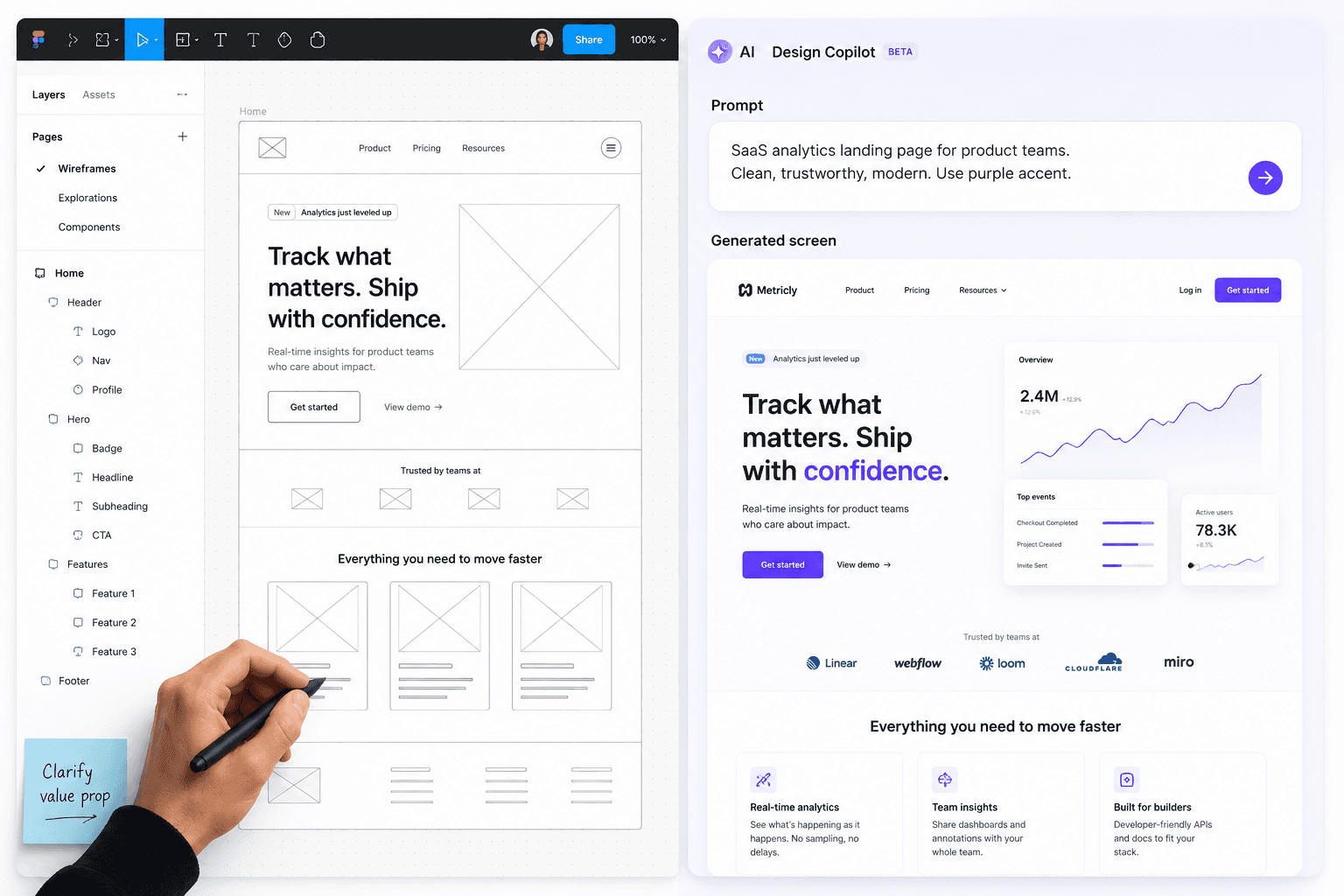
AI has disrupted this sequence at every stage. Research transcripts are now synthesised in hours, not days. Wireframes are generated across multiple directions simultaneously from a well-structured prompt. AI-assisted Figma plugins handle component states, copy variations, and edge cases that would previously consume entire afternoons.
The result is a process where the entire front end of design — research, synthesis, IA, and low-fidelity wireframes — now runs in roughly four to five days instead of three to four weeks.
Before vs. Now — A Phase-by-Phase Comparison
The most concrete way to understand this shift is to compare specific phases directly. In research, we previously spent a full week transcribing user interviews, tagging insights, and organising findings into frameworks by hand.
Today, AI tools synthesise transcripts, cluster themes, and surface patterns we might have missed — in an afternoon. In wireframing, we used to produce two or three directional concepts in a week. With tools like Galileo, Uizard, and v0, we generate six to eight conceptual directions in a day, which means we spend less time on the obvious first answer and more time refining the non-obvious better one.
In high-fidelity UI design, the process itself has not compressed significantly — and this is intentional. We still invest two to three weeks here, because craft, visual hierarchy, motion, and brand expression are irreducibly human decisions. Where AI contributes most in this phase is in the repetitive groundwork: populating component libraries, writing placeholder copy, and generating interaction states across screen sizes. Development handoff has also transformed entirely. Because AI now closes the design-to-code gap — tools like Cursor and Claude Code can scaffold production-ready screens from a Figma file — we begin development in parallel with design, often by week three.
Founders see a working product by mid-project, not at the finish line.
The Honest Trade-offs — Pros, Cons, and Where Craft Still Wins
Like any significant shift in how serious work is done, AI-driven design carries genuine advantages and real risks that deserve an honest assessment. On the advantages side, engagements move thirty to forty percent faster end-to-end, and founders see tangible, tappable output by week two instead of week six.
More design directions are explored per phase, which means the final solution is genuinely selected rather than defaulted to under time pressure. Research synthesis is sharper because we can interrogate the data in ways that were previously too time-consuming to pursue.
The design-to-development gap — historically one of the most expensive inefficiencies in product work — is narrower than it has ever been. On the risk side, the most significant concern is homogenization. AI models are trained on existing design patterns, which means their default output trends toward the average. Without strong editorial judgment driving every decision, products begin to resemble each other at a visual and interaction level that erodes brand distinctiveness.
There is also a real danger in skipping discovery — AI makes it tempting to generate answers before the right questions have been asked, which is a reliable way to ship the wrong product faster. At Dcycle, we draw a clear line: AI does not make decisions on trust signals in fintech flows, accessibility considerations in health products, or the specific micro-interaction details that determine whether a product feels genuinely alive or merely functional.
Those remain designed by hand, on every engagement, without exception. The studios that lead design in the next five years will not be the ones that replaced designers with AI — they will be the ones that used AI to move the value of design up the stack, from execution to judgment, and reinvested the saved time in deeper, more considered craft.